

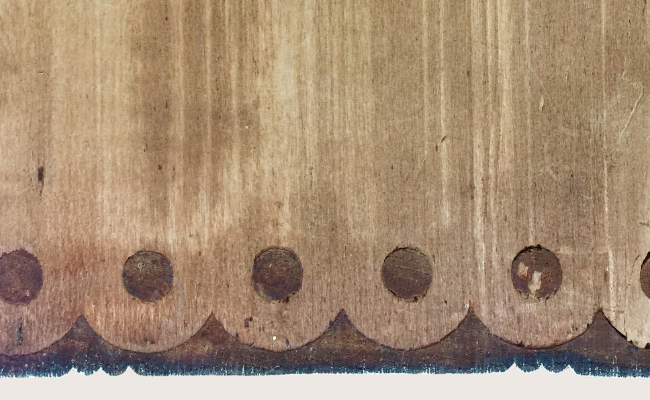
(also called Pin & Crescent, Pin & Cove, Half moon, Scallop & Dowel)
Definition: a woodworking connection where two pieces of wood are joined together by inserting a dowel into corresponding holes drilled into both pieces; only used from 1871- early 1900’s
What exactly are Knapp joints?
You’ll often hear refinishers talk about dovetail joints when discussing the quality of a piece. Typically, dovetail joints indicate a higher quality product.
Knapp joints are known by many names – Pin & Crescent, Pin & Scallop, Pin & Cove, Half Moon and Scallop & Dowel.

It is a series of semi-circles with a hole in the middle cut into the drawer side that match negative semi-circles with integral pegs in the ends of the drawer front.
In 1871, the Knapp Dovetailing Co. of Northampton, Massachusetts, began producing machines to make pin-and-crescent joints, soon nicknamed “Knapp joints.”
These joints had widespread use among furniture companies because they were able to make 10 times more drawers than with hand-cut dovetails.
Between 1871 and 1900 (the end of the Victorian Era), these were used in North American factories.
A closer look


Why did companies stop using Knapp joints?
There were several reasons that companies stopped using Knapp joints:
- Rise of new machinery- Machines were developed in the 1890’s which were able to cut traditional dovetail joints that looked hand made versus the Knapp Joints which looked machine made.
- Change in styles- The curvilinear Knapp joint was a natural fit for the lavish decorative styles of the late 19th century, like Eastlake and similar designs. However, as fashion shifted from Victorian opulence to the Colonial revival and the emphasis on exposed joinery in Arts and Crafts craftsmanship, the Knapp joint found itself out of place. A round, technical looking, obviously machine made drawer joint just did not fit that image.
A closer look

Eastlake Furniture
Eastlake furniture is technically considered Victorian, being popular from 1870 to 1890, but it breaks away from the excessive high-relief carving, classical elements, and numerous curves of other styles produced during this time frame.

Eastlake furniture is more geometric and incorporates more modest curves. The ornamental carving seen on these pieces is most often lightly incised rather than deeply carved.

Overall, Knapp joints, also known as pin and cove joints, are a distinctive feature of Eastlake furniture. These joints consist of a cylindrical pin fitted into a corresponding concave recess, providing a secure and decorative connection between wooden components. These joints not only offer structural integrity but also contribute to the aesthetic appeal of the pieces. Eastlake furniture, characterized by its intricate detailing and angular designs, often incorporates knapp joints to join ornate moldings, panels, and framework, showcasing the craftsmanship and attention to detail typical of the period. Beyond their functional purpose, knapp joints serve as a hallmark of authenticity and craftsmanship, reflecting the distinctive style and construction techniques of Eastlake furniture.

References:
https://www.woodmagazine.com/woodworking-how-to/joinery/pin-and-crescent-joint
https://www.finewoodworking.com/2018/09/26/history-cove-pin-joint
https://www.datamp.org//patents/displayPatent.php?number=388760&typeCode=0
https://furnishgreen.com/fun-furniture-fact-the-knapp-joint/
https://antiquejoinery.wordpress.com/knapp-joint/




Leave a Reply to Howard AARONCancel reply