

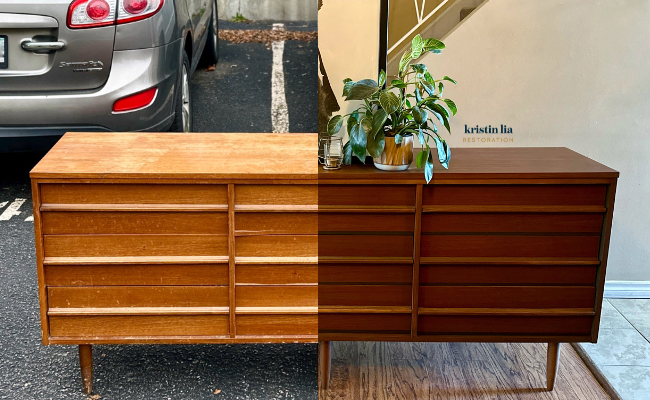
When I was driving to pick a prescription and drove past this piece on the side of the road, I did an immediate u-turn (not quite legal in Canada LOL). There was NO WAY that I could pass this by. I figured out how to load it in my car and then it sat on my main level over the holidays. I finally started it and O M G. It’s going to be incredible.

And look at it now!

Materials:
- Cleaner (non wood surfaces): Rust-Oleum Krud Kutter
- Wood filler: Gork’s Goodfilla Wood Filler in Walnut
- Wood glue: Titebond II premium wood glue
- Wood sealant: Osmo Polyx-Oil Tints in Amber (3072)
- Wood sealant: Osmo Polyx-Oil Clear in Matte
- Canadians – For 10% off Osmo products, send me an email (KristinLia@rogers.com) with the products you love!
- Paint accent: Country Chic Paint – Dark Roast
- Furniture paint touch-up: Coconix Furniture Repair Paint
Tools used:
- SurfPrep 3″X4″ electric ray sander
- DeWalt 5″ random orbit sander, variable speed
- Bahco 1″ carbide tipped scraper with triangle & oval shaped blades
- DeWalt cordless vacuum
- Elite small round (ring) brush
- Country Chic Paint Artist Detail Brushes
- Elite washi tape
- Osmo microfibre roller
- Osmo roller tray
- Osmo Superpad
- Osmo pad holder
- Scotch Painter’s Tape – blue
- Tack cloth
- Bar rags
- Putty knife
- Safety gear- respirator, ear protection, anti-vibration gloves
- 2000 grit sand paper and sanding block
HERE ARE STEP BY STEP INSTRUCTIONS ON HOW I TRANSFORMED THIS MID CENTURY MODERN VICART 9-DRAWER DRESSER:
Sanding & Wood repairs
Here’s how I started on this chest of drawers:
 started by removing the legs and vacuuming the cobwebs from underneath
 removed what felt like 1,000,000 pieces of drawer liners from the inside of the 9 drawers
 using my DeWalt impact driver, I removed the screws holding the handle so I could take it off the front
 it was really a struggle to get this handle off and once it did come off, it was obvious it wasn’t meant to be removed. For this reason, I didn’t remove any more.
 as I removed the liner from each drawer using my Mozart blade, I also did some necessary repairs using Titebond for the loose veneer, Scotch Painters Tape to secure it once it was glued, and Gorks Goodfilla wood filler in walnut to fill in the couple of missing pieces of veneer
 after waiting for everything to dry, it was time to start removing the finish from the handles
 I started with my Bahco 1” carbide tipper pocket scraper using the triangle shaped blade to remove the finish around the handle and in those tight corners of the frame
 scraping helps because it reduces the amount of sanding that needs to be done- especially around those delicate handles; less sanding means less chance of damaging the veneer
 used the cordless vacuum to remove the shavings as I went along
 switched over to the pear (or oval) shaped blade to remove that finish in the groove of both sides of the handle
- finished by cleaning up the entire area using my Tineco vacuum
This prep, especially for 9 drawers, took a while but it really sets up a much easier sanding experience.
So. Much. Sanding.
Now it’s time to remove the finish by sanding! I just was SO excited to see what was under that finish.
Here’s how I removed that original finish:
 for the flat surfaces, I used my DeWalt random orbit sander; I started with 100 grit on medium speed
- this is connected to a DeWalt dust extractor so that all that sanding dust is contained; it allows me to properly sand inside my house
 for all of those gorgeous curved handles, my SurfPrep 3×4 electric ray sander with its foam pads was perfect
 ; I started with a 100 grit film on an interface pad and then switched to a 5mm ProFoam pad in Medium to smooth out; this was also hooked up to my SurfPrep dust extractor
- when done with the curved areas, I switched back to my DeWalt to smooth out those flat surfaces using 150 grit
 I always like to give all of the non-wood surfaces a really good clean using Rustoleum’s Krud Kutter
 usually I just use a bar rag but because of the adhesive left by the drawer liner, I used a scrub brush as well on the drawers
 the water turned pink! I think because the insides must be cherry- I’ll definitely be inserting new ones to protect their clothes
 I changed the water, got a new rag and rinsed any remaining residue
With all of the surfaces prepped, it feels so good to know that the wood underneath was even better than I even imagined!
How to apply paint accent
I was hoping to not have to do a paint accent. But with that little repair I did and the fact that I’m not super confident about my grain matching skills yet, I decided to modernize it just a little. I knew that Country Chic Paint’s Dark Roast would be a perfect complement to that walnut wood.
Here’s how I created the paint accent:
 first lined up the drawers to see what drawers I wanted to apply the accent to
 using Elite washi tape, I first applied to only the middle drawers but that didn’t look right to me
 using a notch on a paint stir stick, I applied the tape to the rest of the surfaces making sure it was even across each one
- for the frame, I marked out just the inside side edges to tie in the accents on the drawers
 used a Country Chic Paint Artist Detail brush to apply the colour “Dark Roast” to the accent areas
- let dry for a few hours

 applied the second coat
- this colour has amazing coverage and with it being such a small area, it was easy to make sure it was applied evenly
This colour is always such a good pairing with walnut wood. I’m really looking forward to applying the sealant to the wood and see that grain emerge!
How to seal wood & paint with Osmo
The day for applying the wood sealant is finally here!!! I am always so excited for this part of the process. I knew that this wood will look spectacular with Osmo Polyx-Oil Tints in Amber applied. Country Chic Paint does have a built-in top coat but I like adding the extra durability.
Here’s how I applied the wood sealant to seal both the wood and the paint:
- started by removing the Elite tape and applying more along the areas the edges I want to protect
- gave the Polyx-Oil Tints a really good stir to incorporate any of the pigments that settled on the bottom; poured into the tray
 to apply I used an Elite flat brush for the edges and a microfibre roller for the flat surfaces
 it can be applied in all directions but it’s important to finish with long, even strokes with the grain
- when done applying, I let dry for 24 hours
- in between each coat, I lightly sanded with a 400 grit foam pad
 removed the dust with a tack cloth
- this ensures a super smooth surface free of dust- and in my case, dog hair

 repeated the same process to apply the second coat using Osmo Polyx-Oil Clear in matte
- let dry overnight but only 8-10 hours required
- lightly sanded again
 for the 3rd and final coat, I buffed in the oil using an Osmo Superpad
- this means that I did gentle circles with the oil until it was all absorbed into the surface
- finished with long, even strokes to make sure that no swirl marks remained
I am obsessed with this grain and the way this product has highlighted it, is absolutely incredible.
Finishing Touches
This is it. Where it all comes together. The pairing of Osmo Polyx-Oil Tints in Amber and Country Chic Paint’s Dark Roast is truly incredible.
Here’s how I finished up this gorgeous VicArt MCM 9-drawer dresser:
- fixed a broken drawer guide
- 👴🏻 Used Grandpa Ernie’s sanding method for all the wood surfaces for a “smooth like butter 🧈” finish; let me know if you need a further explanation

- reinstalled that one drawer handle
 cut drawer liners from Amazon to size and installed
- reinstalled the legs
- removed the tape
 put the drawers back in their proper locations
From a roadside find to a gorgeous piece of art! I am just thrilled with how I managed to transform this piece. Now it’s time to print pictures of what it looks like now and mail them to the original owners!
Have you ever found a roadside treasure??


I'd love to know what you think!