


Originally, I found one of these HPL Mobilier nightstands at the Mission Thrift Store. Then, by some stroke of luck, FOUND A MATCHING ONE on Facebook Marketplace!! It’s so rare to have a pair of nightstands and I was so happy to have them together.

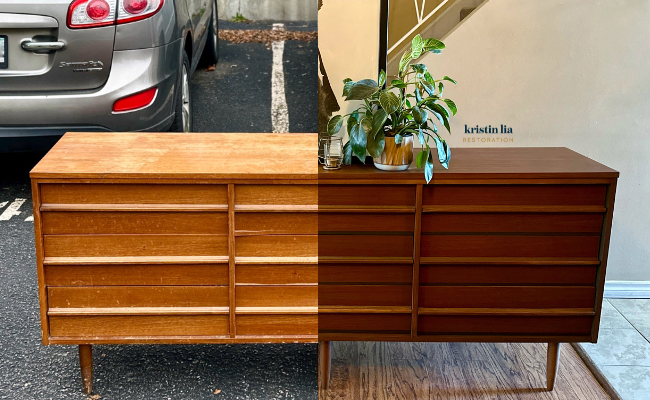
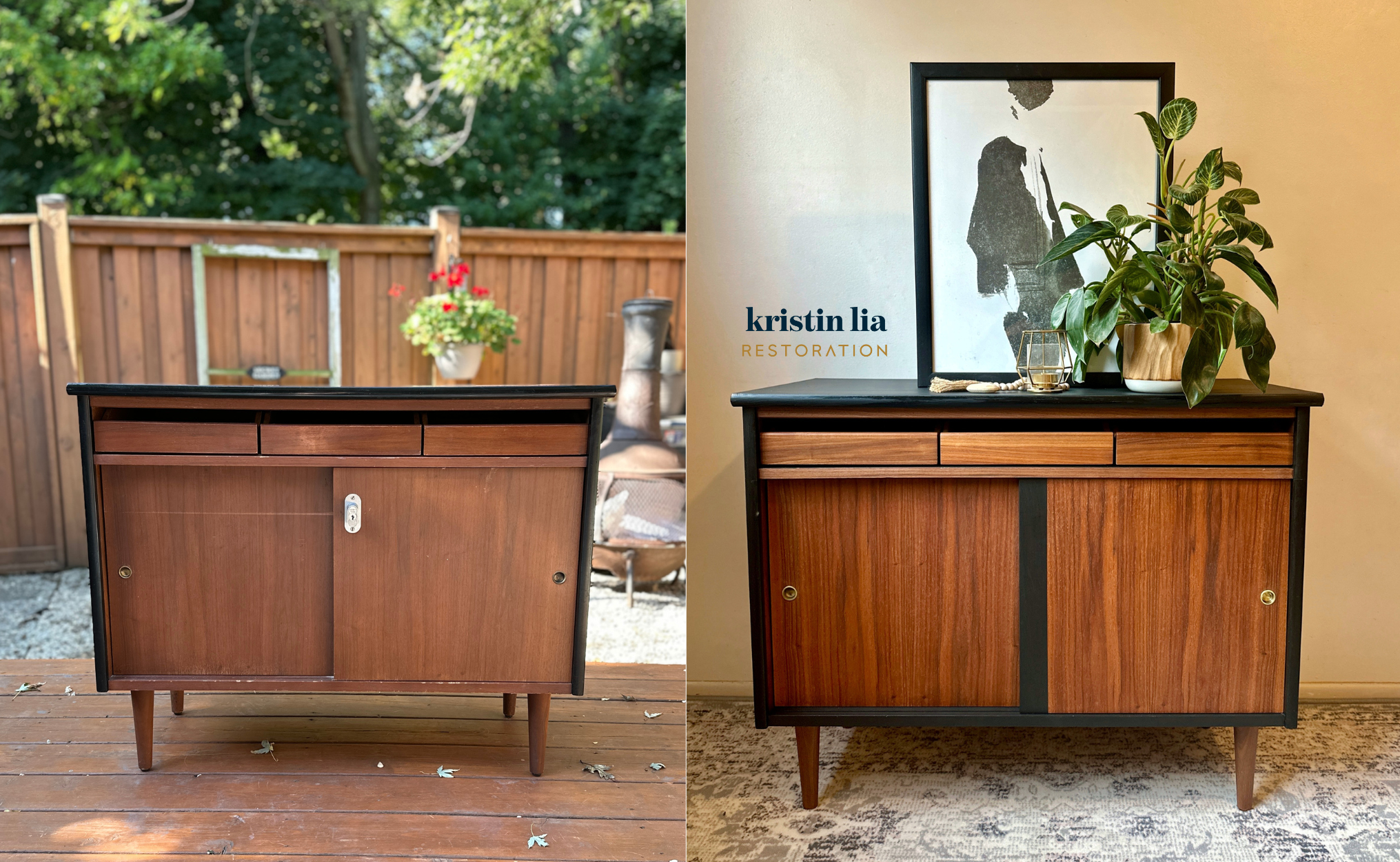
And look at it now!

Materials:
- Cleaner (non wood surfaces): Rustoleum’s Krud Kutter
- Wood sealant: Osmo Oil Stain in Tobacco
- Wood sealant: Osmo Polyx-Oil Tints in Amber
- Wood sealant: Osmo Polyx-Oil Clear in Matte
- Canadians – For 10% off Osmo products, send me an email (KristinLia@rogers.com) with the products you love!
- Coconix Furniture Repair Paint
Tools used:
- SurfPrep 3″X4″ electric ray sander
- SurfPrep 5″ Electric Ray Gen 2+
- Bahco 1″ pocket scraper with triangle shaped blade
- DeWalt impact driver
- DeWalt cordless vacuum
- Elite small round (ring) brush
- Elite washi tape
- Osmo microfibre roller
- Osmo roller tray
- Osmo Superpad
- Osmo pad holder
- Tack cloth
- Bar rags
- Safety gear- respirator, ear protection, anti-vibration gloves
- 2000 grit sand paper and sanding block
HERE ARE STEP BY STEP INSTRUCTIONS ON HOW I TRANSFORMED THIS SET OF NIGHTSTANDS:
Here’s how I prepped it:
 using my DeWalt impact driver and a pair of pliers, removed the legs and the bottom frame; this makes sanding SO much easier
 these drawers have a raised front that could be easily damaged if not careful
 with my Bahco 1” pocket scraper and using the triangle shaped blade, I delicately removed the original finish from the drawer fronts
 used my DeWalt cordless vacuum to remove the shavings as I went along
 tried to remove the top but it was not budging; so I resecured the screws
Disassembling really makes accessing the wood surfaces from all angles a lot easier. This, in turn, makes the likelihood of damaging or burning through the veneer a lot less.
Next up I’m going to be using my new SurfPrep 5” random orbital sander for the first time. I’m both nervous and excited 
This project was going to be my first time using my new SurfPrep Sanding’s 5” random orbital sander. I’ll admit I was nervous but couldn’t have been happier with how it performed!
Here’s how I sanded:
 made sure that the sanders were connected to my new SurfPrep vacuum/ dust extractor
 started with a 100 grit film on the orbital sander on medium speed
- for the curved edges of the drawers, my 3×4 electric ray sander was perfect; with the original finish already scraped, all I needed to do was sand with a 5mm ProFoam pad in Medium
 I LOVE that both of my sanders can be hooked up to the sander at the same time; it saves me switching out the hoses every time I need to change sanders
 removed the dust from all the wood surfaces using a tack cloth
 used Rustoleum’s Krud Kutter to give the inside of the frame and the inside and outsides of the drawers (everything except the wood surfaces)
 rinsed any remaining residue with clean water and a new rag
My overall opinion: I adore this new sander. I love its comfortable design and how much lighter it feels in my hand. I’m still getting used to how it works on the edges but I’m so confident that this is going to be the best addition to my tool arsenal
With this set of nightstands completely prepped, it was time for the wood sealant. As usual, I turned to my Osmo products to see which one would be best.
Here’s how I started treating the lighter wood surfaces:
 started by protecting all the surfaces I didn’t want to stain using Elite washi tape
- I poured Osmo Tobacco Oil Stain into a small container for easier access
- with my Elite brush, I applied the oil stain to the front of one of the nightstands
 I tried wiping it back but it was definitely not the look I was going for; in fact, I HATED it
 I had to wait for it to dry before I sanded it
- in the meantime, decided on Osmo Polyx-Oil Tints in Amber for surfaces instead
- tried sanding but the surface still wasn’t dry and it clogged up the sanding disc

 once dry, I re-sanded the stained surfaces, removed the dust with a tack cloth and re-applied the tape to the edges
- applied the Polyx-Oil to the front frame
- let dry for 24 hours
Sometimes a design doesn’t go to plan- and that’s okay!! With most issues capable of being fixed or modified, giving an idea a fair shot is always worth it.
I love when all the elements start to come together! The secret to a durable Osmo finish is to slowly build it.
Here’s how I continued sealing the wood surfaces:
 lightly sanded all surfaces with 400 grit foam pad and removed the dust with a tack cloth
 stirred the Osmo Polyx-Oil and poured into the tray
 for the legs and edges, applied with Elite flat brush
 for the flat surfaces (drawers, sides), applied with a microfibre roller
- let dry overnight but only 8-10 hours required
- lightly sanded all surfaces with 400 grit foam pad and removed the dust with a tack cloth
 the secret to a durable Osmo finish is to slowly build it; because of this, I applied the second coat
- let dry 8-10 hours
- lightly sanded all surfaces with 400 grit foam pad and removed the dust with a tack cloth
- touched up a couple of spots using Coconix Furniture Repair paint
- let dry
 started by drizzling some of the Polyx-Oil onto the surface
 using an Osmo Superpad on a pad holder, did gentle circles with the oil until it was all absorbed into the surface
 finished with long, even strokes with the grain
- let dry overnight
I didn’t need to apply the second coat of Polyx-Oil to the bottom frame and legs because they had already been treated twice. Getting close to the end and these are really coming along
Finding each of these nightstands separately to make a pair was truly remarkable. While the style matches, the wood grain pattern is uniquely different. I love how this characteristic makes them so gorgeous. I just adore this set!
Here’s how I finished them off:
- I should have marked which drawers belonged to which set but of course, I didn’t
- lined up the drawers, frames and legs as best I could
 finished all surfaces with Grandpa Ernie’s sanding method; let me know if you need further information
- installed the base and drawers on one of nightstands
- when I went to install the base on the other, realized that the screw holes didn’t match up
- so I took the base off the first one, reinstalled on the second and vice versa
This rare set of MCM nightstands were truly a gift to restore. Now they can live a second life!



I'd love to know what you think!