

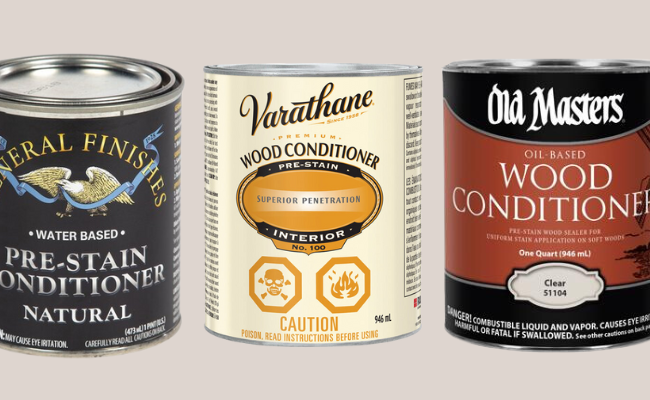
Definition: a liquid product that is applied to raw wood before staining to help the wood absorb the stain more evenly by reducing the effects of uneven wood grain
What exactly is a pre-stain wood conditioner?
The purpose of a wood conditioner is to partially seal the grain of porous wood, which allows the stain to penetrate evenly and provide uniform color. Most formulas call for a high concentration of solvents, such as petroleum distillates or naphtha, carrying a dissolved solid, such as styrene plastic or an alkyd resin.
In other words, a wood conditioner is basically a wood finish reduced to a very thin consistency.
While a wood conditioner may have the same composition as a wood finish, it isn’t a finish, and it shouldn’t remain on the surface. It’s important for it to soak deeply into the wood.

It works by filling the pores in the wood. Think of this like construction workers filling potholes in a road before applying blacktop.
Analogy courtesy of @the.handymans.daughter
Why use pre-stain wood conditioner (PSWC)?
- PREVENTS BLOTCHING:
- Different parts of the wood absorb stain differently, resulting in uneven coloring. PSWC seals the wood surface, reducing the amount of stain that penetrates deep into the wood, which in turn minimizes the risk of blotching.
- ENSURES EVEN COLOUR:
- By reducing the amount of stain that penetrates deep into the wood, PSWC helps ensure that the stain color is uniform across the entire wood surface, resulting in a more consistent finish.
- HELPS STAIN PENETRATE:
- Applying a PSWC opens up the pores of the wood, allowing the stain to penetrate more easily and evenly.
- MAKES WOOD EASIER TO WORK WITH:
- PSWC can help reduce splintering, and it also makes the wood more receptive to sanding and other finishing techniques, which can help create a smoother surface.
Types of wood conditioner
There are two main types of commercial pre-stain wood conditioner: water-based and oil-based. There are DIY recipes available.
RULE OF THUMB- USE WATER BASED PSWC WHEN USING WATER BASED STAIN AND OIL BASED PSWC WHEN USING OIL BASED STAINS.
Water-Based Pre-Stain Conditioner:
- popular choice for softer woods like pine or cedar
- generally easier to clean up and dry more quickly than oil-based products
- do not raise the grain of the wood as much as oil-based products, making them a good choice for wood that has already been sanded smooth
- tend to have less odour than oil-based products
Refinishers recommend:

Oil-Based Pre-Stain Conditioner:
- typically used for hardwoods like maple, oak, and cherry
- tend to penetrate more deeply into the wood, providing better protection against moisture and other environmental factors
- have a higher viscosity than water-based products, which can make them easier to apply and give them a longer drying time
- also tend to raise the grain of the wood more, so additional sanding may be required after application
Refinishers recommend:

When choosing a pre-stain conditioner, be sure to consider the type of wood you are working with, the type of stain you plan to apply, and any other products you may be using in your finishing process.
How to apply wood conditioner?
Application of wood conditioner varies by manufacturer but here are some basic guidelines.
- Before applying, your surface must be smooth (sanded) and clean of any dust or lint. Sand open-grain wood (e.g., oak, ash, mahogany) with 120-grit, followed by 150-grit, then 180-grit. Sand closed-grain wood (e.g., cherry, pine, maple, birch) with 150-grit followed by 220-grit.
- Brush a thin layer of conditioner on the surface in the direction of the grain.
- Dip a natural bristle brush,rag, or sponge into the wood conditioner and apply even strokes to the wood.
- Cover the entire piece of wood evenly with a thin layer of the product.
- The wood should be without any other finishes on it before using the wood conditioner.

- This is where the manufacturer’s instructions widely vary.
- Some companies want you to apply liberally, wait for a specified amount of time, remove excess and then apply stain within a certain window. Others ask you to apply, let dry for a certain time and then apply your stain.
PLEASE FOLLOW THE INSTRUCTIONS ON THE PRODUCT YOU ARE USING.

Apply the conditioner evenly: Avoid over-saturating the wood with the conditioner, as this can cause the wood to become too wet and may interfere with the staining process
- Don’t forget! If you forget and don’t come back to your project until after the specified staining window, the conditioner will act more like a sealer, and prevent the stain from penetrating into the wood.
- Sweet spot: Applying stain too soon may just dilute the color without preventing blotching, but waiting too long may prevent the stain from soaking in at all.
Wood conditioner & paint washing
A pre-stain wood conditioner is not necessary when doinga paint wash because the purpose of a pre-stain wood conditioner is to help even out the absorption of stain, which is not a concern when using paint.
Stain is designed to penetrate the wood and enhance the natural color and grain of the wood, while paint sits on top of the wood and provides a protective layer. A paint wash involves thinning down paint with water or another solvent to create a translucent layer of color that allows the wood grain to show through.
Because paint does not penetrate the wood in the same way that stain does, a pre-stain wood conditioner is not necessary before applying a paint wash. However, it is important to properly prepare the wood surface by cleaning and sanding it to ensure the paint adheres well and the finish is even.
Questions
Does wood conditioner affect the colour of the stain?
Stain can be slightly lighter after using wood conditioner because the conditioner prevents uneven absorption of the stain. In the process, it prevents as much stain from being absorbed overall, leading to a lighter color.
Is sanding required after using wood conditioner?
After using a water-based wood conditioner, the grain will typically raise and feel rough to the touch. A fine-grit sandpaper can be used to smooth out the surface.
Note: For oil-based products, once you’ve sanded initially, you won’t need to sand again.
How can wood conditioner that’s been left on the surface too long be fixed?
If the wood conditioner is left on for too long, it can be fixed by lightly scuffing up the surface with 220 grit sandpaper.
A differing opinion
Wood finishing expert Bob Flexner believes instructions given by manufacturers are incorrect.
His reasoning? Because this is an ultra-thin finish, you should let the finish dry completely, then apply the stain. Otherwise, he says, the wood conditioner is simply diluting the stain. While this does reduce penetration, he feels a better result is achieved by letting the wood conditioner dry completely.
EXAMPLE:
He applied conditioner to the board. Left side he let dry “within 2 hours” and on the right, overnight.

As you can see, the left side is blotchy and the right side is not.
Pre-stain wood conditioner is a crucial step in achieving a professional and polished finish for your woodworking projects. Its importance lies in its ability to even out the absorption of stain, thereby preventing blotching and ensuring a consistent color application. Whether opting for an oil-based or water-based conditioner depends on factors such as drying time and personal preference, but both types offer excellent results when applied correctly.
While conventional wisdom may suggest leaving the conditioner on for 15 to 30 minutes before wiping off the excess, some craftsmen argue for shorter or longer durations based on their experiences. Ultimately, finding the optimal timing may require experimentation and may vary depending on factors such as wood type, humidity, and environmental conditions.
In essence, incorporating pre-stain wood conditioner into your woodworking routine not only enhances the final appearance of your projects but also showcases your attention to detail and dedication to craftsmanship. By understanding its importance, choosing the right type, mastering application techniques, and heeding expert advice, you can elevate your woodworking endeavors to new heights of excellence.

References:
https://www.hunker.com/13414010/how-to-make-your-own-pre-stain-wood-conditioner
https://woodworkly.com/what-does-wood-conditioner-do/
https://www.homedit.com/wood-conditioner/
https://www.minwax.com/en/products/preparation/pre-stain-wood-conditioner
https://topwoodworkingadvice.com/pre-stain-wood-conditioner/
https://www.youtube.com/watch?v=kt7lrXy7D9A#t=37s (Minwax USA)
https://www.wikihow.com/Stain-Wood
https://www.homedit.com/how-to-stain-wood/
https://www.thehandymansdaughter.com/wood-conditioner/
https://www.popularwoodworking.com/finishing/how-wood-conditioners-are-giving-washcoats-a-bad-name/
https://generalfinishes.com/wood-finishes-retail/water-based-wood-stains-and-dye-stains/water-based-pre-stain-conditioner
https://generalfinishes.com/wood-finishes-retail/oil-based-wood-stains-sealers/oil-based-pre-stain-wood-conditioner
https://www.rustoleum.com/product-catalog/consumer-brands/varathane/premium-wood-conditioner
https://www.behr.com/consumer/products/wood-stains-finishes-cleaners-and-strippers/water-based-interior-wood-stains/behr-water-based-pre-stain-wood-conditioner/
https://www.behr.com/consumer/products/wood-stains-finishes-cleaners-and-strippers/oil-based-interior-wood-stains/behr-oil-based-pre-stain-wood-conditioner
https://myoldmasters.com/product/wood-conditioner
ChatGPT search: explain why a pre wood stain conditioner is not necessary before a paint wash



I'd love to know what you think!